
STRATEGY AND RISK MITIGATION: REDCO PRESENTS AT SME MINEXCHANGE A MODEL FOR THE TRANSITION TO UNDERGROUND MINING
With the imminent depletion of the world’s large open pits, the Chilean consultancy presented a “De-Risking” framework. The model integrates financial, stochastic and socio-environmental variables to ensure the viability of mining megaprojects, challenging traditional planning paradigms.
The transition from open pit mining (Open Pit) to underground mining methods (Underground) has become one of the most complex strategic and financial challenges in the useful life of a mining operation. As orebodies reach greater depths, companies face an exponential increase in operating costs, geotechnical difficulties, and growing pressure to reduce their environmental footprint and carbon emissions.
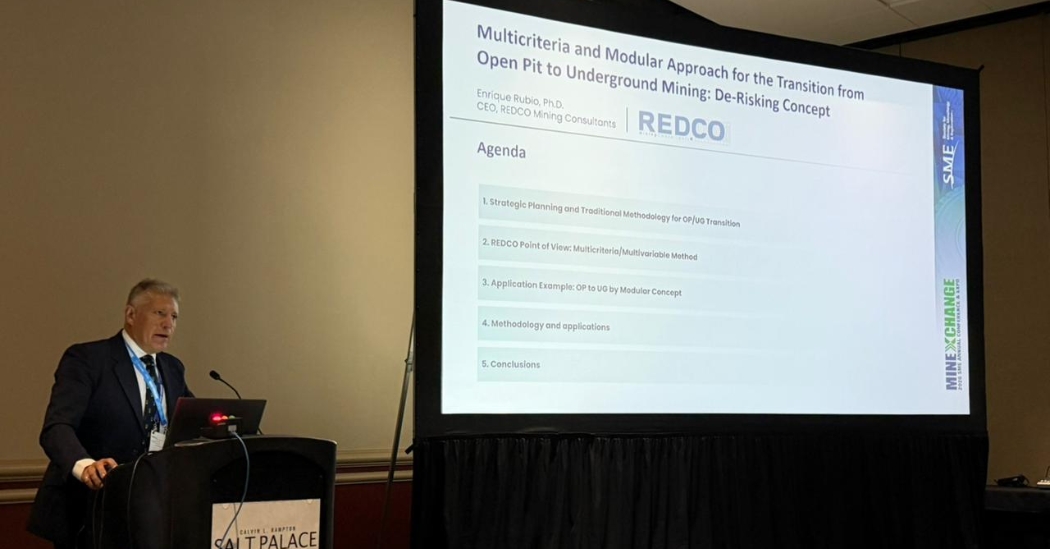
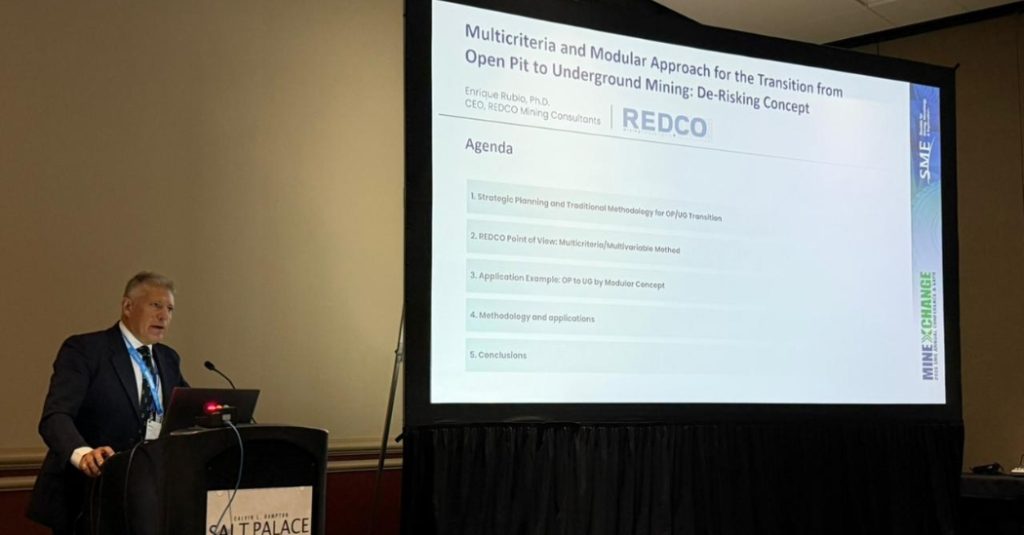
In this context, the boutique mining engineering consultancy REDCO set the tone during the technical sessions of the international conference Minexchange 2025, organized by the Society for Mining, Metallurgy and Exploration (SME), in the city of Salt Lake, United States. The presentation, delivered by Enrique Rubio, the company’s Executive Director, detailed the scope of the study “Multicriteria and Modular Approach for the Transition from Open Pit to Underground Mining: De-Risking Concept”. The paper proposes a paradigm shift in the way boards and technical teams assess these multibillion-dollar investments.
Historically, the industry has addressed the transition problem sequentially. Conventional methods tend to optimize the final pit in isolation and, only afterwards, plan a complementary underground operation. This lack of integration prevents critical synergies from being captured, ignoring, for example, how the dimensions of the bridge pillar (crown pillar) affect both geotechnical stability and total economic recovery. Moreover, traditional deterministic models underestimate geological and market uncertainty, which often results in an overvaluation of the project.
To resolve this, REDCO’s methodology incorporates in-house computational tools (SIMPLAN for operational performance and SIMVAL for economic evaluation) that make it possible to run Monte Carlo simulations across the entire mining value chain. Instead of delivering a single static figure, the model produces probability distributions that quantify the project’s Value at Risk (VaR), defining pessimistic (P10) and optimistic (P90) scenarios.
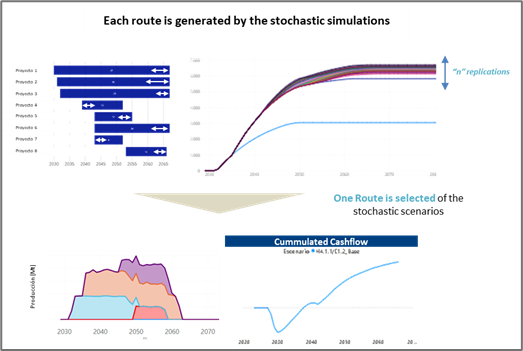
During his presentation, Rubio underscored the corporate impact of this approach: “Addressing pit and underground mine planning jointly makes it possible to identify synergies and define the optimal transition point that truly maximizes business value. Quantifying stochastic risk (whether geological, operational or market-related) and reflecting it in corporate decision-making is critical to avoiding future surprises. We have shown that a route with a slightly lower Net Present Value (NPV) may be preferable if its risk profile is substantially lower “.
A differentiating pillar of the framework presented is the adoption of a modular implementation strategy, based on the concept of “De-Risking” (risk reduction). Instead of injecting all the capital into an immediate underground megaproject, the approach proposes starting with smaller-scale pilot operations.
Matías Fuentes, Technical Services Manager and author of the research, explained the logic of this structure: “We propose a gradual approach that allows the early start-up of a pilot underground mine. During this operational phase, the organization gains practical experience, refines the actual geotechnical parameters and calibrates the production model. Deferring CAPEX until a greater degree of certainty is reached substantially reduces the risk of investing billions in an underground facility that could perform below expectations.
This approach also provides invaluable adaptive flexibility. If the actual geomechanical conditions differ from the initial studies, the company can adjust the extraction method (for example, scaling horizontally through selective stopes instead of vertical massive caving) without compromising financial viability.
A successful transition does not depend solely on financial profitability. The methodology assesses each development route along two fundamental axes in a multicriteria analysis: Attractiveness (financial metrics such as NPV, IRR, C1/AISC operating costs and useful life) and Executability (technical, logistical, regulatory and socio-environmental factors).
ESG considerations (Environmental, Social and Governance) play a decisive role on this axis. Operating underground radically reduces the surface footprint, noise, dust and greenhouse gas emissions compared with open pit mining. However, the matrix strictly assesses the time required to obtain new permits and community perception of possible subsidence risks or impacts on aquifers, ensuring that the plan is implementable in the real world.
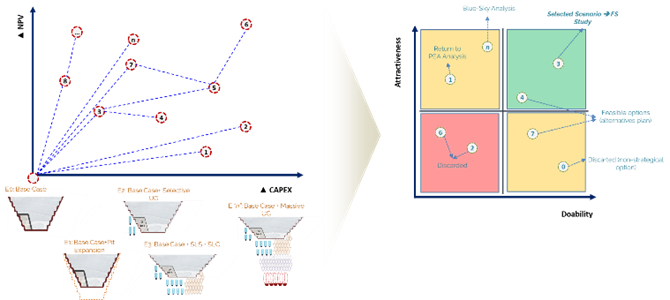
The effectiveness of the model is not theoretical. During the presentation, anonymized results were shown from its application at an Andean copper mine site and a phosphate deposit in Brazil.
In the Brazilian case, three paths were compared: continuing the pit to its economic limit (Route A), implementing a massive underground mine early on (Route C), and an intermediate modular route (Route B). Although Route C promised the highest theoretical NPV ($325 million dollars), it presented very high investment risk and low executability due to logistical stress. Route B (Modular), with an average NPV of $310 million dollars, stochastically dominated the others by offering 40% lower capital risk exposure and ensuring operational continuity without production gaps, becoming the recommended strategic option.